

When planning a new driveway, patio, pool deck, or walkway, one of the biggest decisions homeowners face is choosing between interlocking pavers and poured concrete.
Both materials are popular throughout Rancho Cucamonga and the Inland Empire, but they perform very differently over time. Factors such as durability, appearance, maintenance, weather resistance, repair costs, and long-term value all play a role.
Many homeowners initially choose concrete because of the lower upfront cost, only to discover years later that cracking, discoloration, and difficult repairs can make it more expensive in the long run.
Interlocking pavers, on the other hand, offer flexibility, beauty, and exceptional durability, making them one of the most popular choices for Southern California outdoor living spaces.
This guide explains the differences between pavers and poured concrete so you can determine which option is right for your home.
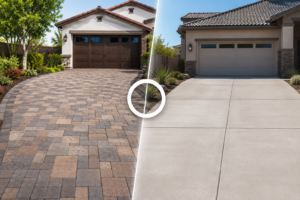
Understanding Interlocking Pavers
Interlocking pavers are individual concrete stones installed over a compacted aggregate base and bedding sand. Instead of creating one large slab, hundreds of individual pieces work together to form a flexible and durable surface.
Because they move slightly with soil expansion and contraction, pavers are highly resistant to cracking.
Homeowners commonly use pavers for:
- Driveways
- Patios
- Pool decks
- Front entrances
- Walkways
- Courtyards
- Outdoor kitchens
Benefits of Interlocking Pavers
Superior Appearance
Pavers come in:
- Numerous colors
- Multiple textures
- Contemporary styles
- Traditional designs
- Various laying patterns
Popular options include:
- Belgard Catalina Grana
- Belgard Origins
- Belgard Dimensions
- Aqualine permeable pavers
The design possibilities are nearly endless.
Exceptional Durability
Pavers are designed to withstand:
- Vehicle traffic
- Extreme temperatures
- Heavy foot traffic
- Soil movement
- Seasonal weather changes
Individual pavers often exceed 8,000 PSI strength, significantly stronger than standard residential concrete.
Easy Repairs
One major advantage of pavers is repairability.
If a section settles or becomes stained:
- Remove affected pavers.
- Re-level the base.
- Reinstall the original stones.
Repairs are virtually invisible.
Concrete repairs usually leave patches and color differences.
Increased Property Value
Beautiful hardscaping improves:
- Curb appeal
- Outdoor living functionality
- Home resale value
Many buyers view paver driveways and patios as premium upgrades.
Understanding Poured Concrete
Poured concrete creates one continuous slab that is formed and finished on-site.
Concrete remains popular because:
- Installation is relatively straightforward.
- Initial costs are lower.
- It offers a clean appearance.
Applications include:
- Driveways
- Sidewalks
- Patios
- Garage slabs
Although concrete performs adequately, it has limitations homeowners should understand before investing.
Comparing Pavers and Concrete
Appearance
Pavers
Provide:
- Rich textures
- Decorative borders
- Color combinations
- Elegant patterns
- High-end curb appeal
Concrete
Offers:
- Basic gray finish
- Stamped designs
- Colored finishes
Over time, concrete tends to fade and show imperfections.
Winner: Interlocking Pavers
Durability
Pavers
Because they are flexible, pavers adapt to ground movement.
They resist:
- Cracking
- Expansion damage
- Freeze-thaw cycles
- Minor settling
Concrete
Concrete slabs naturally develop:
- Hairline cracks
- Surface fractures
- Expansion joints
Cracking is often unavoidable.
Winner: Interlocking Pavers
Maintenance
Pavers
Maintenance includes:
- Occasional sealing
- Replenishing polymeric sand
- General cleaning
Concrete
Maintenance may involve:
- Crack filling
- Pressure washing
- Surface sealing
- Patch repairs
Both require maintenance, but paver repairs are far simpler.
Winner: Interlocking Pavers
Repair Costs
Individual stones can be removed and replaced.
Repairs blend seamlessly with surrounding areas.
Concrete
Repairing concrete frequently requires:
- Saw cutting
- Demolition
- Re-pouring
Color matching can be difficult.
Winner: Interlocking Pavers
Lifespan
Pavers
With proper installation and maintenance, pavers often last 30–50 years or more.
Concrete
Concrete driveways generally last 20–30 years before requiring significant repairs.
Winner: Interlocking Pavers
Cost
Concrete
Lower upfront investment.
Pavers
Higher installation costs but greater long-term value.
Many homeowners discover that avoiding future repairs offsets the initial price difference.
Why Soil Conditions Matter in the Inland Empire
Homes throughout:
- Rancho Cucamonga
- Upland
- Claremont
- Redlands
- Riverside
- Ontario
Experience soil movement and temperature fluctuations.
Because concrete is rigid, it can crack when the ground shifts.
Interlocking pavers are flexible and better suited for Southern California conditions.
Which Material Is Better for Driveways?
Driveways must withstand:
- Vehicle weight
- Heat
- Expansion
- Daily traffic
Interlocking pavers outperform concrete because they:
- Resist cracking.
- Handle heavier loads.
- Maintain their appearance longer.
- Increase curb appeal.
Which Material Is Better for Patios?
Patios are outdoor gathering spaces where appearance matters.
Pavers provide:
- Endless design choices.
- Decorative borders.
- Modern styles.
- Slip resistance.
Concrete offers fewer customization options.
Pool Deck Considerations
Pool decks need:
- Safety
- Comfort
- Durability
Pavers are ideal because they:
- Stay cooler underfoot.
- Offer better traction.
- Resist cracking.
- Are easier to repair.
Common Misconceptions About Pavers
“Pavers Shift Easily”
Properly installed pavers remain stable for decades.
Professional excavation and base preparation are the key.
“Concrete Doesn’t Crack”
All concrete eventually cracks.
The question isn’t if—it is when.
“Pavers Require Too Much Maintenance”
Modern polymeric sand and sealers make maintenance relatively simple.
Frequently Asked Questions
1. Are pavers stronger than concrete?
Yes. Individual pavers often exceed the strength of traditional concrete.
2. Do pavers increase home value?
Absolutely. They enhance curb appeal and outdoor functionality.
3. Are pavers worth the additional cost?
For many homeowners, the durability and easier repairs justify the investment.
4. How long do paver driveways last?
Thirty to fifty years or longer with proper installation.
5. Do pavers crack?
Individual pavers rarely crack, and damaged stones can easily be replaced
Why Homeowners Across the Inland Empire Choose Belman Pavers
At Belman Pavers, we specialize in custom:
- Driveways
- Patios
- Walkways
- Pool decks
- Outdoor living spaces
Our installations are built on proper excavation, compacted base material, and proven installation techniques designed to deliver decades of performance.
If you’re considering a new driveway or patio, our team can help you determine whether interlocking pavers or concrete is the best solution for your property.


